





 History


As most people know, a reason for the existence of the wide spectrum of skin tones that we have today is a result of humans living in and adapting to various different environments. Dark skin was favored closer to the equator because it shields tissue from dangerous UV rays. In regions with less sun, lighter skin is developed to allow the body to absorb enough UV rays to synthesize vitamin D, which is needed for healthy bones and immune systems.
Nowadays, you can pretty much find skin colors across the whole spectrum in any corner of the Earth. Some places are slightly more homogeneous than others, as the result of such things as purposefully prohibiting outside immigration for several generations, extremely long term geographical isolation, or even just such a thorough blending of the gene pool that the average skin tone has become a fairly consistent mix of all the varying tones that once existed there.
Despite this, we still widely use colors to name and distinguish perceived “categories” of people. “White”, “Black” and “Brown” are the most commonly used. Of course, there are the categories “Red” and “Yellow”, used to describe Indigenous North Americans and natives of the Asian continent, respectively. While these were once more common like the others, they have since become racist (or colorist) slurs and are now seen as taboo, offensive, and inappropriate.
When skin-tone isn't on either extreme side of the spectrum it’s hardly relevant.
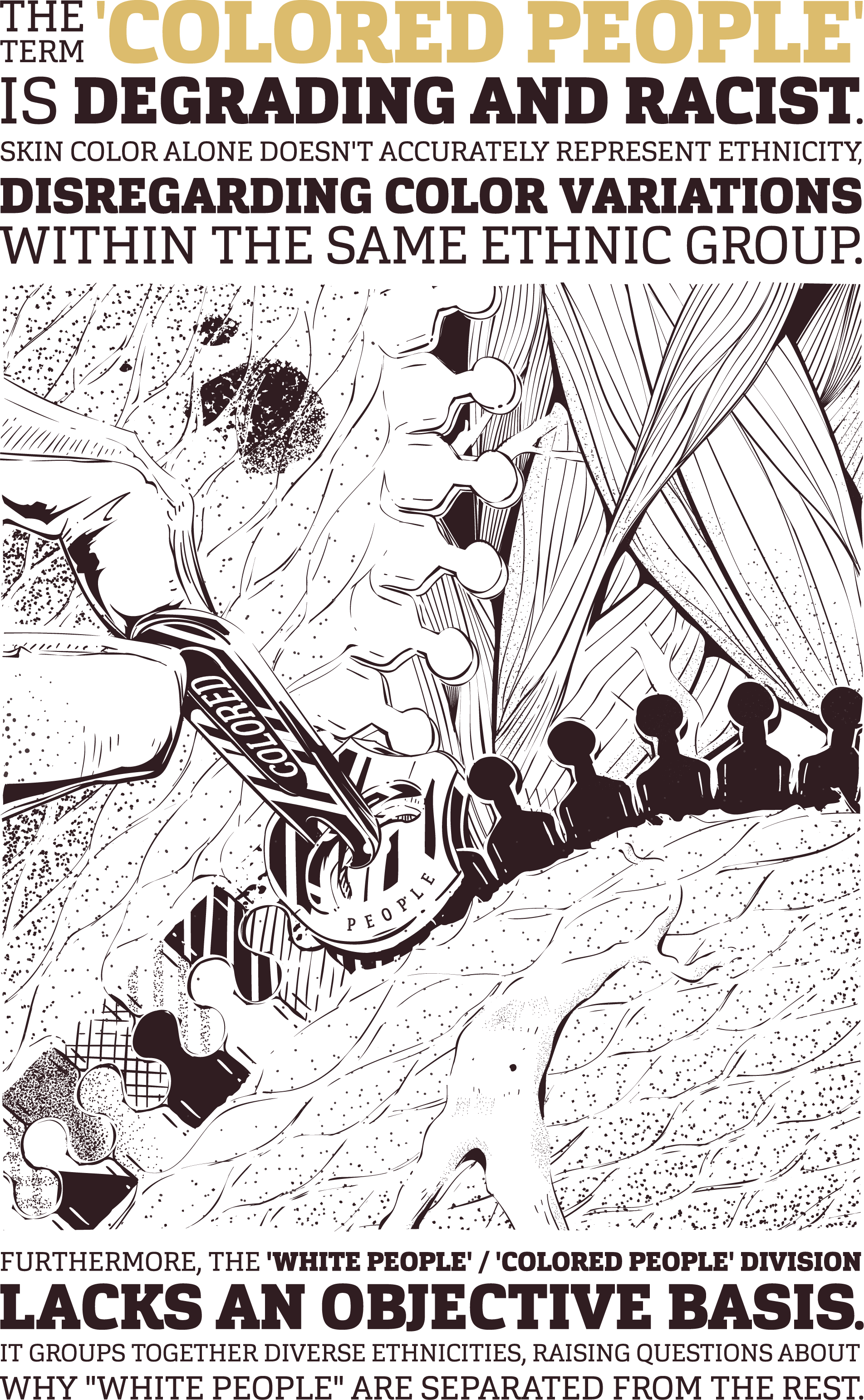
How do people even get sorted into these categories, and why did we start using them in the first place? When a skin tone isn't on either extreme side of the spectrum it’s hardly relevant. “White” people do not have truly white skin, but rather a range of hues such as peach, tan, beige, and even darker. In fact, many people with light skin become dark in the summer sun. Yet, we still call them “White.” So if skin tones exist on a spectrum, and can change drastically from environmental factors throughout the course of a single year, can we even categorize them?
Furthermore, skin colors often vary drastically even among members of the same ethnicity. While we tend to think of geographical regions producing homogeneously-skin-colored populations, human genetics is in reality much more diverse. For instance, light skin doesn’t come from one gene which originated in one area of the world. Light skin actually has several origins.
According to current findings, a key gene mutation promoting lighter skin (SLC24A5) occurred 29,000 years ago in Asia and later spread into Europe. Africa is also a source of three other gene variants that contribute to lighter skin in populations around the world (DDB1, MFSD12, and HERC2). So it’s common sense that this variation in the gene pool of a certain region would result in members of the regional population having quite a spectrum of skin colors.
For example, the Western world might categorize Arabs as “Brown,” but their skin colors actually range from deep brown all the way to pale. Scandinavians are famously considered “White,” but there are many a Scandinavians whose skin color would be considered dark. Southern Europeans, such as Italians, Spaniards, and Greeks, weren’t considered White just a century ago. They also shared the same Mediterranean climate as North Africa and the Levant.
But today, these same Southern Europeans have been welcomed into the “White” race. Their skin color didn’t change- but their culture did. The label “European Blacks” was once used to discriminate against Italians and other Southern European immigrants in early-day America, but once the general White public warmed up to them and began to feel like they were proving themselves as “one of them,” they suddenly became “White,” like everybody else.
The idea of race is hardly about skin color at all; it’s about culture. When European travelers first encountered dark-skinned people, they didn’t immediately dislike them because of their skin color. They looked down upon them because they considered their unfamiliar lifestyles “savage,” and then, because they had no capacity to understand the physical and cultural differences between them and the other group, chalked their “savageness” up to the made-up reason that there must be something innately different between people with light skin and people with dark skin. Therefore, skin color became a functional indicator of culture, and dark skin tones became associated with inferiority.
The Italian-American example mentioned earlier is a clear example of how narrow-minded concepts of race are used to judge people and to justify that judging. America is historically notorious for its particularly vitriol racism against “Blacks,” which are mostly people of African heritage. So, rather than say they didn’t like the Italians because they were “bad,” Americans just categorized them as “Black.” In American culture, everybody “knew” that Black = bad, and it had already been long-established that Black people were outsiders and inferiors. So, if they categorized the Italians as Black, they could easily ostracize them.
But here’s the thing- they didn’t call the Italians just “Black,” they called them the “Blacks of Europe.” But if they truly believed Italians were Black, they would not make a distinction between the Black people of Africa and the Black people of Europe, because it’s the skin tone that indicates your character, right? The White Americans gave themselves away by making a distinction of the Italian’s geographical region, demonstrating that it wasn’t necessarily their skin color that bothered them- it was their culture and what is represented. Italians were not the only European immigrants to get such treatment- Greeks, Poles, Hungarians, Slavs, and even the Irish faced similar discrimination upon arrival and would hang in a limbo of sociocultural status for a few generations before they had eventually proved their “Whiteness”- aka, their prejudice toward Black people- enough to be accepted to the same or similar societal status.
In short, White Americans were afraid of new immigrants coming in and messing up their culture of superiority, and these new groups of immigrants had to work hard to accrue wealth, contribute to society, and help protect White supremacy to prove that they were not biologically and culturally inferior. And most did, because they saw from America’s prejudice against “Blacks” how much worse life in America would be if they were not accepted as White. Discrimination toward these “new immigrants” was actually just Nationalism confused as and entangled with Racism. To be a true American was to be both White (and everything it stood for), and a White supremacist.
Color is not truly the determination of a group: any combination of shared culture, heritage, language, and nation or geographical region is what binds a group together and separates it from other groups. But because of the language we use for our categories and the long history we have of associating certain skin tones with a certain culture, we’ve become blind to the wide range of human diversity, and instead simplified peoples’ entire physicality and identity down to a handful of one-size-fits-all skin colors. People often look for clues in one's physical or cultural features other than skin tone to guess the region of origin and then label that person with a color regardless of his actual skin tone.
Not only are these color-based distinctions a simplistic and arbitrary means of unfairly categorizing people, today they can be narrow-mindedly harmful and exclusive. For people who don’t have the physical features generally used to identify and determine a group - in this case, skin tone - they are, in the eyes of society, not seen as a legitimate part of that culture.
Fair-skinned individuals who have African heritage and grew up in “Black” North American or European culture are often told they’re not “black” enough, or asked why they don’t just call themselves White so they don’t have to explain “why they call themselves Black when they don’t look Black.” A Black person with a darker skin tone (and therefore, according to the concept of race, more obviously “Black) would not be questioned in the same way because of the ingrained, underlying (and often subconscious) presumption that all people of the same “race” more or less have the same culture and heritage, which is obviously not true.
So according to this line of thinking, the more you “look” like your race, the more you deserve to be a part of it and participate in its culture. These categorizations based on skin colors can strip people of their heritage and culture and, conversely, impose on them a heritage or culture that is not theirs.
While the more Northern European-influenced “Western” world has subscribed to these concepts of race, other regions weren’t so preoccupied with color in the same way. Skin color did not have the same cultural significance or connotation in many Eastern countries as it did in Europe and the Americas. In India, for example, many of the supreme deities, including Shiva, Rama, and Krishna, were depicted as dark blue or black. But this depiction of skin color wasn’t based on the genetics of real people; rather, these colors were chosen because they are said to symbolize the dark clouds that bring rain to the fields and, by extension, the prosperity that accompanies a plentiful harvest.
The Hindu socio-cultural system is also not primarily based on race. People are traditionally divided into castes that are exclusive, hereditary, and perpetuated through marriage. The castes were all unequal to each other and were ranked by superiority in the same way Westerners thought of race, but this system isn’t based on any type of physical trait. People of all sorts of physical variations belong to each caste, because the caste system is basically divided by what type of job you have, and therefore how “pure” you are considered. In addition to the main castes, there are thousands of additional subdivisions which have many different systems of rank, but none of the ranking features for any caste derive from skin color or any notion of “race.”
India is famously a nation of very diverse physicalities, from fairly light skin to very dark skin, and a stock of facial features which run the gamut. Some early 20th-century European scholars even tried to divide the Indian and other Asian peoples into races but were unable to due to the sheer complexity of physical variations in India, parts of Southeast Asia, and Melanesia. Around this time, science was also undergoing a revolution where old ideas were being thrown out and replaced by new ones, and this also hindered their attempts at dividing and grouping the Indian and Asian people.
If you move even further East than India, you will find Japanese paintings depicting encounters with European missionaries in the 17th century. These paintings emphasize differences in the shapes of noses, and variations in hair and eye color, but depict the skin tone of visiting Europeans as the same as themselves. In some Asian cultures, Europeans are sometimes referred to as “red faces” or “red people,” while in other cases, the Chinese and Japanese are labeled as “white people.”
Cultures in some Asian countries actually did draw lines of distinction based on skin tone, but it wasn’t because of any concept of race or racial hierarchy. In these specific cultures, skin tone reflected one’s economic, and by extension social, statuses: the lighter your skin was, the wealthier you were perceived to be because you did not have to labor outdoors (and thereby become tan from the sun). Even today, some people of specific Asian heritages who live in cultures that do not have this view will be very conscious about going out in the sun, using sunscreen, and covering their skin when they go out, due to their ingrained notion of status, and by extension, beauty.
While the Western idea of race is still widely accepted by even some of the most educated among us, history tells us that many cultures throughout the history of humanity have had quite different opinions. Opinions which, in many cases, are far more aligned with the biological reality of our genetics than the Western idea of “race” is. If we wish to make any meaningful type of distinctions, we should do so based on culture and values. After all, those say much more about who we actually are than our skin color, which pretty much just tells you what combination of gene frequencies a person happened to get from their forebears.


