





 History
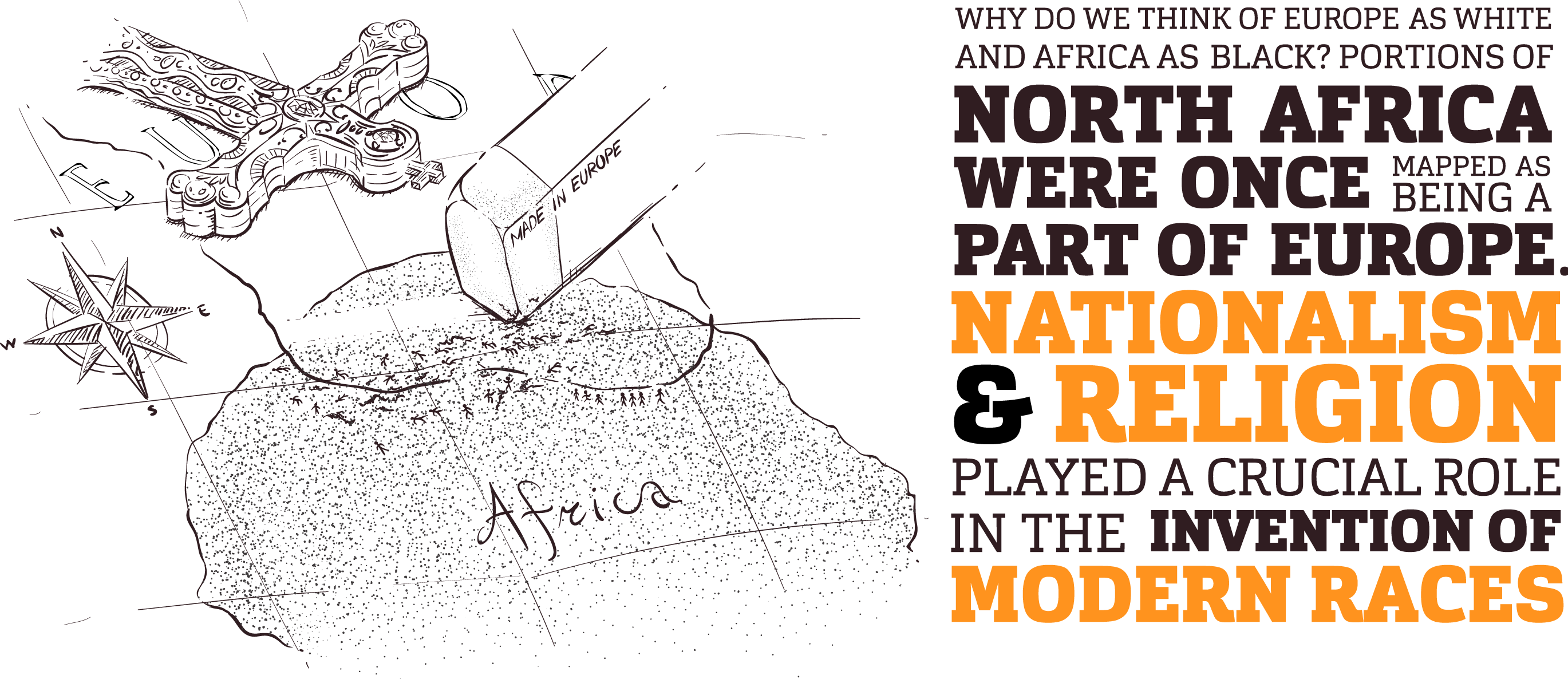


When we think of the different continents of the world, we usually think of a large landmass that’s mostly separate from others, with a more or less homogenous group of people who have similar cultures and languages. The terms “Asian,” “African,” “South American,” and so on are used to generalize all the people of the region, and usually bring a picture of a certain “type” of person to mind when they are spoken.
In the modern world, the word continent can refer to either a cultural and political distinction, or a geographic one. The first distinction- cultural and political - is concerned only with human society, while the second distinction- geographic - is based purely on the land itself, with no regard to how the humans inhabiting it divide and organize themselves.
These two definitions lead to varying perspectives on the precise borders of continents, and how these borders impact human populations. An interesting historical case of changing continent boundaries gives us a window into how these borders impact the people in and around them.
The history of Africa and Europe as continents is extremely complex. Through the centuries, their people have witnessed the rise and fall of many empires, which continually shifted the dividing lines of the continents. At various points in time, portions of today’s North Africa were included in what was then known as Europe, while portions of modern Europe were not a part of historical Europe at various points in history.
[Carousel. Swipe through images to see the evolution of Europe’s map. Starting from year 1 all the way to 2000]
While the borders of Europe and Africa have been turbulent over the years, we’re able to track them through history and know what happened and when. However, our knowledge of the origins and meaning of the continent name “Africa” is much murkier. Some believe that the name "Africa" is derived from the Berber tribe Afri, who lived in the Carthage area - now modern-day Tunisia. The Romans, on the other hand, called the region Afri-terra, meaning "the land of the Afri," which many people believe later became combined to create "Africa."
Other historians suggest that the suffix "-ica" could have been used to mean "the land of the Afri," in the same way that Celtica means "the land of the Celts." It’s also possible that the name was a misinterpretation of the Berbers’ own name for the place in which they lived: The Berber word ifri means cave.
Nevertheless, the name "Africa" has been in use since Roman times. Initially, however, it only referred to the northern part of what is now Africa. It did not come to represent the entirety of the landmass of Africa we know today until quite sometime later. Back then, the divisions of the continents as we know them now didn’t exist. So why do people still associate these continents with certain racial groups, despite the fact there are no fixed traits which are exclusive to any one continent?
Nations have always considered themselves to be the center of the world. It’s not a notion reserved for one particular nation or culture. The Europeans perceived themselves as “White”, but so did the Arabs, who in pre-Islamic Arabia gave people with dark skin the name and - meaning “worshipper” or “slave.” The invention of racial groups came from scientists of a Western European perspective, so it’s not hard to imagine nationalism played a role.
This idea of a “White Europe” eventually spread further throughout the world and manifested itself in peoples’ minds. This happened initially primarily through colonialism and was later rapidly accelerated and expanded with the rise of Nazism, whose adherents claimed that the “Aryan race” was the superior race.
The introduction of European theories of race in the 1800s had an enormous impact almost everywhere in the world. Scientific racial theories were recognized as part of Western knowledge, and thus symbolized “modernity,” a concept that was idolized by many other regions and countries on the globe.
Western racial characterizations spread to other parts of Asia in the latter half of the 1800s. These classifications not only justified the superior social position of European colonizers in regard to Asian “subordinates,” but also evolved into detailed subdivisions between colonial subjects themselves, wherein the elite began to characterize “tribes” and other marginalized groups as “barbarian” and “primitive.”
In colonial India, the British anthropologists who conducted ethnographic research built reciprocal relationships with Indian elites. In doing so, they constructed a defense of India’s notorious caste system, which distinctly and harshly sorted the population into a cruel hierarchy based on genetics. This defense was based on the “scientific” analysis of cranial differences between members of different castes.
While we now know that the average brain of any human, regardless of region or genetic background, does not differ from another, these racially-motivated and misconceived findings were taken seriously at the time. The apparent “cranial differences” between castes indicated that Bengali upper castes were Aryan in origin and that the lower castes such as foragers and shepherds were, under the theory of social Darwinism, destined to die out.
Thus, in the closing decades of the 1800s, the idea of race gained a particular meaning in colonial Southeast Asia and India—a meaning that supported public policies which were beneficial to colonizers and the ruling classes and very injurious to non-elites, who were presumed to be on the path to extinction.
Even in the relatively recent past, derogatory racial distinctions were common in so-called “advanced” and “civilized” societies, such as those in North America. Though Italian descendants living in the United States are known nowadays for having a strong connection to their rich Italian ancestry and culture, they are still considered as part of the modern-day “White” population of America.
Not too long ago, however, Italians and those of Italian heritage faced strong discrimination by the “White” community. Faced with a flood of new European immigrants who threatened the established culture of White Protestant America, the country adopted new, more restrictive views of whiteness, which ranked certain Europeans as “more or less white” than others. Italians ranked near the bottom of this list, and while they were not subjected to slavery in the same way that Africans were in the country, they were treated similarly in many ways, essentially representing the “European Black,” or as they were sometimes called, “The White N***er.”
Only with the establishment of Columbus Day, a day to honor the Italian explorer who is said to have “discovered” America, did Italians begin to “earn” their place in American White society. Interestingly enough, Columbus Day has in the last decade or so been increasingly under attack in the United States, due to its celebration of a man who brutalized indigenous nations across several landmasses and islands and instigated genocides of entire populations of peoples.
With this knowledge, it’s not hard to see that a crucial part of the Italian’s acceptance by White Americans was the sensationalizing of close ties to a nationalist figure, and, subsequently, racism towards Indigenous and Black people. Once their connection with such a figure, and therefore the ideology he represented, became emphasized and well-known, they were then welcomed into the circle of the “superior” Whites.
To demonstrate just how effective these concepts of continentally-based racial groups are, consider the fact that many people still can’t comprehend why many Berber tribes have a light skin tone, despite being located in the northern part of Africa.
This has forced many to come up with far-fetched explanations in an attempt to revise established history so it can fit into their idea of racial constructions. A good example for this is the cult named Black Hebrew Israelites, who falsely claim that the Berbers, Egyptians, and Hebrews were originally “black”, and that the current inhabitants of North Africa have stolen their culture, languages, and history – consequently “whitening” that area in a continent that, as “Black” individuals, they view as being rightfully theirs.
Similarly, “White” supremacists also try to claim the Egyptian heritage as their own, saying that the area that was once “pure” has now been “tainted”
Both of these ideologies are a product of racialism and nationalism. Their basis lies in an entirely fabricated belief that race is an inherently obvious genetic factor that separates humankind into distinct categories, which can be ranked in order of superiority. When these ideologies are faced with historical fact or scientifically-vetted truths, subscribers to them will often devise their own, uninformed, and largely or wholly false versions of history in an attempt to explain and defend these views.


